

|
Key Takeaways
|
Walk down the gin aisle and the labels quickly multiply: London Dry, contemporary, Old Tom, Navy Strength, pink, sloe. Each one promises something different, yet they all start with the same berry.
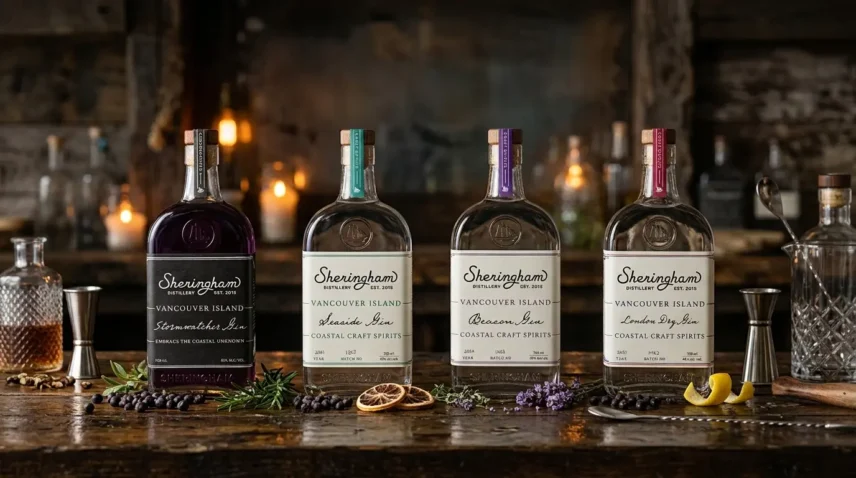
This guide explains the types of gin in plain language, what each label actually means and how to choose a bottle for the way you like to drink. Along the way it uses real examples from Sheringham Distillery on Vancouver Island, whose range covers several gin styles under one roof.
What Are the Main Types of Gin?
The main types of gin are London Dry, contemporary or New Western, Old Tom, Plymouth, Navy Strength, genever, flavored gin, sloe gin and barrel aged gin. Each style shares juniper as its foundation but differs in sweetness, botanical balance or production method.
A helpful way to group them is by what changes from one style to the next. Some styles are defined by rules about sweetening and flavoring, such as London Dry. Some are defined by botanical balance, such as contemporary gin. Others are defined by history, origin or an added ingredient.
|
Type of gin |
What defines it |
Flavor in brief |
Sheringham example |
|---|---|---|---|
|
London Dry |
Botanicals added during distillation, no sweetening |
Juniper forward, crisp, dry |
London Dry Gin |
|
Contemporary / New Western |
Juniper shares the stage with other botanicals |
Varies: floral, citrus, herbal, coastal |
Seaside, Beacon, Raincoast |
|
Floral gin |
A contemporary gin led by flowers |
Fragrant, soft, aromatic |
Beacon Gin |
|
Old Tom |
A historic, slightly sweeter style |
Rounder and softer than London Dry |
Not produced; see the Martinez below |
|
Plymouth |
A traditional English regional style |
Earthy, gentle juniper |
Not produced |
|
Genever |
Dutch and Belgian spirit with a malt wine base |
Malty, bready, juniper |
Not produced |
|
Flavored gin |
Gin with added fruit or other flavors |
Fruit led |
Not produced |
|
Gin liqueur and sloe gin |
Sweetened drinks on a gin base |
Sweet and fruity |
Fresh Lemon and Fresh Rhubarb Liqueurs |
The table also answers a common search, types of gin brands. Rather than memorizing brand names, it is more useful to recognise the style on the label. Most distilleries describe their gin as one of these types, and that word tells you more about the taste than the brand alone.
The sections below take each type of gin in turn, starting with the rules that every gin shares.
What Makes a Gin a Gin? Juniper and the Legal Basics
A gin is a spirit whose main character comes from juniper berries. That single requirement links every style in this guide, from a bone dry London Dry to a sweet sloe gin.
Canada sets out its gin standard in section 2.3.2 of the Canadian Food Compositional Standards, Volume 2. Gin there is a potable alcoholic beverage made by redistilling alcohol from food sources with or over juniper berries, or by blending that spirit with other alcohol from food sources. Other aromatic botanicals may be added during redistillation, along with a sweetening agent and a flavouring preparation that keeps the flavor consistent.
In the United States, federal rules likewise require gin to take its main characteristic flavor from juniper berries. In the European Union, gin must also be juniper led, and the separate categories of distilled gin and London gin add stricter rules about how botanicals are introduced.
|
Rule |
What it means for the style |
|---|---|
|
Juniper must lead |
Every type of gin tastes recognisably of juniper |
|
Other botanicals are allowed |
This freedom creates contemporary, floral and regional gins |
|
Sweetening is permitted for gin in Canada |
Sweeter styles such as Old Tom can exist under the gin name |
|
Dry and London Dry require no added sweetening |
These labels signal a gin with nothing sweet added |
|
Genever is treated separately |
Canada excludes Hollands, Geneva and Genever from its gin standard |
Understanding these basics makes labels far easier to read. Dry tells you about sweetness. Contemporary tells you about botanical balance. Liqueur tells you the drink has been sweetened and sits in a different category.
It also explains why the gin category is so varied. As long as juniper leads, a distiller is free to tell a story with the rest of the recipe, and many of the most interesting types of gin come from that freedom.
What Does London Dry Gin Actually Mean?
London Dry gin is a style of gin, not a place of origin. It describes a gin flavored with botanicals during distillation and with no sweetening added afterwards, so a London Dry gin can be made anywhere in the world.
In Canada, the rule is clear: a gin may be labelled Dry Gin or London Dry Gin only if no sweetening agents have been added. European rules for London gin go further, requiring natural botanicals introduced during distillation, no added colouring and only a minimal trace of sweetening.
The word dry refers to sweetness, not texture. A London Dry gin tastes crisp because nothing sweet softens the juniper and citrus. That clean profile is why the style became the backbone of classic cocktails such as the martini and the gin and tonic.
Sheringham London Dry Gin shows the style clearly. Its botanicals are juniper and citrus, and Sheringham describes a balanced bouquet of bright juniper and citrus with a crisp, dry finish and a faint trace of spice. It is made on Vancouver Island, which shows how the London Dry name travels.
London Dry suits people who like juniper front and center. It is the reference point for every other style in this guide, and tasting a good London Dry first makes it easier to notice what contemporary and floral gins add.
One practical tip: if a recipe simply says gin, a London Dry is the safe default. It will give the classic balance the bartender intended, from a Tom Collins to a Negroni.
For a gin drinker exploring different types of gin, London Dry is the starting line. Everything else is a variation on, or a reaction to, this crisp and classic style.
What Is a Contemporary or New Western Gin?
A contemporary gin, also called New Western gin, keeps juniper as the base but gives other botanicals an equal or leading role. The result can be floral, citrus led, herbal or even coastal, depending on what the distiller chooses to highlight.
Where a London Dry gin puts juniper first and everything else in support, a contemporary gin rebalances the recipe. Juniper is still present, as every gin standard requires, but flowers, herbs, tea or local plants share the spotlight.
Sheringham groups three of its gins under the contemporary heading on its spirits page: Seaside, Beacon and Raincoast. Each one leans on a different set of botanicals, which makes the range a useful way to understand how broad the contemporary style can be.
Sheringham Seaside Gin is the clearest example. Its botanicals include juniper, rose, lavender, citrus, coriander, cardamom and locally harvested winged kelp, which gives a subtle taste of the ocean. The gin was named World’s Best Contemporary Gin at the World Gin Awards in 2019, a title that sums up the style well.
The kelp, lavender and rose are what make Seaside distinctive. The Sheringham botanicals guide explains how the winged kelp is hand harvested on Vancouver Island and how the lavender comes from Victoria Lavender Farm, giving the gin a floral, coastal identity rooted in its home.
Contemporary gins reward people who enjoy discovery. Two contemporary gins can taste completely different, because the defining choice is no longer juniper but whatever the distiller pairs with it.
That variety is also why contemporary gins are so popular with home bartenders. A floral contemporary gin can transform a simple gin and tonic, while a herbal one adds depth to a martini.
Floral Gin: How Flowers Shape the Glass
Floral gin is a contemporary gin in which flowers such as rose, lavender or cherry blossom lead the flavor. Juniper remains in the base, but the aroma and finish are shaped by fragrant, soft botanical notes.
Sheringham Beacon Gin, formerly Kazuki Gin, is the floral heart of the range. Its botanicals include juniper, coriander, grapefruit, green tea, cherry blossoms and yuzu peel. Cherry blossoms add a floral, fruity character with polished, rounded edges, and green tea brings a delicate herbal finish.
The green tea has a local story. According to the Beacon Gin botanicals guide, the tea is grown by Westholme Tea Company, Canada’s first commercial organic tea grower, and gives the gin a beautiful herbaceousness. That herbal note keeps the floral character balanced rather than perfumed.
Seaside Gin also carries a floral side, through rose and lavender, but it balances those flowers with the savory note of winged kelp. Placing Beacon and Seaside side by side shows two very different ways a floral gin can be built.
|
Floral gin |
Floral botanicals |
Balancing notes |
Try it in |
|---|---|---|---|
|
Beacon Gin |
Cherry blossoms |
Green tea, yuzu, grapefruit |
A gin and tonic with a citrus twist |
|
Seaside Gin |
Rose, lavender |
Winged kelp, cardamom, citrus |
The Perfect Seaside G&T |
People searching for floral gin brands often want a gin that tastes lighter and more aromatic than a classic London Dry. A floral contemporary gin delivers exactly that, while still tasting unmistakably of gin.
Floral gins shine in simple serves. Tonic, soda or a light sour lets the flowers come through, while heavily spiced mixers can cover them up.
Coastal and Forest Gins: Taste the West Coast
Coastal and forest gins are contemporary gins built around botanicals from a specific landscape, such as ocean kelp or rainforest plants. They capture a sense of place, which is why many people seeking a distinct gin experience start here.
Sheringham makes two gins that show this idea from different angles. Seaside Gin looks to the ocean, with winged kelp harvested on the coast of Vancouver Island. Raincoast Gin looks inland, to the temperate rainforest.
Sheringham Raincoast Gin combines juniper with nettle, oak moss and citrus. Sheringham describes it as a bright and balanced, approachable gin inspired by fresh rainfall and the temperate rainforest, with subtle coastal character from the nettle and oak moss. It earned a Silver medal at the World Gin Awards in 2024.
These landscape driven gins sit naturally within the contemporary style. Juniper still leads, as the gin standard requires, yet the supporting botanicals do something a classic recipe never could: they make the gin taste of a specific coastline or forest.
Raincoast shows its character best in a stirred drink. The Raincoast Martini combines 2 oz Sheringham Raincoast Gin with 0.5 oz Noilly Prat dry vermouth, 0.25 oz Martini Bianco vermouth and a pinch of sea salt, stirred until chilled and finished with a lemon twist. Sheringham describes it as herbaceous and fresh.
For anyone asking what gin to try for a distinctive tasting experience, a coastal or forest gin is a strong answer. Tasting Seaside and Raincoast side by side shows how two gins from the same distillery can express the ocean and the rainforest of one island.
This is also where the types of gin move beyond categories into storytelling. A label might say contemporary, but the botanicals tell you where the gin comes from.
Old Tom Gin: The Sweeter Classic
Old Tom gin is a historic style of gin that is slightly sweeter and rounder than London Dry. It was popular in 18th and 19th century England and sits, in flavor, between a crisp London Dry and a malty genever.
Old Tom has no single legal definition in Canada, the US or the EU, so recipes vary from one producer to the next. What unites them is a softer, gently sweet profile, which is possible because the gin standard permits a sweetening agent. A sweetened Old Tom cannot carry the Dry Gin label in Canada.
The style matters most in cocktail history. The Tom Collins is traditionally linked to Old Tom gin, and the Martinez, often described as an ancestor of the martini, is commonly associated with it too.
Sheringham does not make an Old Tom, but its Martinez recipe shows how the style’s classic cocktail works with a contemporary gin. It combines 1.5 oz Sheringham Seaside Gin, 1.25 oz sweet vermouth, 0.25 oz maraschino liqueur and 2 dashes of aromatic bitters, stirred, chilled and strained into a martini glass. Sheringham calls it a rich, fruity martini variation that calls for a cherry on top.
Using Seaside Gin in a Martinez brings floral and coastal notes to a recipe built for sweetness. The sweet vermouth and maraschino supply the roundness that Old Tom would traditionally add, so the drink keeps its classic balance.
Old Tom suits people who find London Dry too sharp, and cocktail fans who want to recreate drinks as they were first made. It is a reminder that gin was not always dry, and that sweetness has its own place in gin history.
Plymouth, Navy Strength and Genever: Other Traditional Styles
Plymouth gin, Navy Strength gin and genever are three traditional types of gin with distinct histories. Plymouth is an English regional style, Navy Strength has naval roots, and genever is a malt based spirit from the Netherlands and Belgium.
Plymouth gin takes its name from the English port city of Plymouth. It is usually described as softer and earthier than London Dry, with gentler juniper, and it has long been used in classic martinis.
Navy Strength is a traditional style bottled at a higher strength, a name linked to the British Royal Navy.
Genever, also called jenever or Hollands, is the ancestor of modern gin. It is made with a malt wine base, which gives it a rich, bready character quite unlike a London Dry. Canada treats it separately: the Canadian gin standard explicitly excludes Hollands, Geneva and Genever style gin.
|
Style |
Origin |
Character |
Classic use |
|---|---|---|---|
|
Plymouth |
Plymouth, England |
Soft, earthy, gentle juniper |
Classic martini |
|
Genever |
Netherlands and Belgium |
Malty, bready, juniper |
Sipped or stirred, Old Fashioned style |
|
Barrel aged gin |
Modern craft trend |
Gin rested in wood for rounder flavor |
Stirred drinks |
Barrel aged gin deserves a brief mention here too. It is gin that has rested in wood, picking up color and rounder flavors, and it bridges the gap between gin and aged spirits. In Canada, age claims on gin labels are generally not permitted, so labels focus on the wood rather than the number of years.
These traditional types of gin are worth knowing even if they are not everyday choices. They explain where modern gin came from, and many classic recipes were written with one of them in mind.
Flavored Gin vs Gin: What Is the Difference?
The difference between flavored gin and gin is that flavored gin has additional fruit or other flavors added to a juniper based spirit, usually giving it a pronounced fruit character and often a color. Standard gin gets its flavor from botanicals introduced during distillation.
Flavored gins have grown quickly, especially pink and fruit led styles. Some are simply gin with a fruit flavor added after distillation. Others are lightly sweetened. The label usually signals the main flavor, such as strawberry, orange or rhubarb.
The rules shape how these gins are labelled. A gin with added sweetening cannot be labelled Dry Gin or London Dry Gin in Canada, and in Europe a London gin cannot have flavourings added after distillation. That is why a flavored gin will rarely carry a London Dry label.
Flavored gin sits on a spectrum. At one end is a contemporary gin whose fruit or flowers come from botanicals in the still, such as Beacon with its grapefruit and yuzu peel. In the middle is a flavored gin with fruit added afterwards. At the far end is a gin liqueur, which is fully sweetened and covered in the next section.
Knowing where a bottle sits on that spectrum helps with cocktails. A contemporary gin swaps easily into any classic recipe. A flavored gin works best in simple mixed drinks that let the fruit lead. A gin liqueur is often enjoyed on its own over ice or with bubbles.
For a fruit led experience without leaving the gin category, a citrus forward contemporary gin is a good choice. Beacon Gin brings grapefruit and yuzu from the still, so the fruit is part of the gin itself rather than added later.
Gin Liqueur vs Gin: Is a Gin Liqueur the Same as Gin?
No, a gin liqueur is not the same as gin. A gin liqueur is a sweetened drink made on a gin base, usually with fruit, so it is softer, sweeter and fruitier than gin. Sloe gin, made by steeping sloe berries in gin, is the best known traditional example.
Sheringham makes two gin based liqueurs. Sheringham Fresh Lemon Liqueur is made with a gin base specifically crafted to pair with the juice of premium lemons, and the fresh, tart notes of the lemon are gently sweetened. Sheringham describes it as perfectly tart and sweet.
Sheringham Fresh Rhubarb Liqueur combines a classic gin base with premium rhubarb grown in British Columbia, with star anise and lemon skins added during maceration. The result is a balance of tart, sweet and subtly vegetal notes, inspired by Master Distiller Jason MacIsaac’s memories of cooking with rhubarb from his garden.
|
|
Gin |
Flavored gin |
Gin liqueur |
|---|---|---|---|
|
Base |
Juniper led spirit |
Gin |
Gin |
|
Sweetness |
Dry or lightly sweetened |
Often lightly sweetened |
Clearly sweetened |
|
Flavor |
Botanical |
Botanical plus added fruit |
Fruit led, tart and sweet |
|
Typical serve |
G&T, martini, Negroni |
Simple mixed drinks |
On its own over ice or with bubbles |
|
Sheringham example |
Seaside, Beacon, Raincoast, London Dry |
None |
Fresh Lemon and Fresh Rhubarb Liqueurs |
Sheringham suggests enjoying the Lemon Liqueur in a simple cocktail or on its own shaken over ice, and the Rhubarb Liqueur on its own or with ice and bubbles. Both work well for people who find straight gin too sharp but enjoy botanical, fruit forward flavors.
The key takeaway is labelling. If the bottle says liqueur, expect sweetness and fruit. If it says gin, expect juniper first.
Which Type of Gin Should You Try for a Distinctive Tasting Experience?
For a distinctive tasting experience, try a contemporary gin built around regional botanicals, such as a coastal gin with ocean kelp or a floral gin with cherry blossom. These styles offer flavors that classic recipes do not, while still tasting clearly of gin.
The right type of gin depends on what you already enjoy. The table below matches common preferences with a style and a Sheringham example.
|
If you enjoy |
Try this type of gin |
Sheringham example |
|---|---|---|
|
Classic, crisp martinis |
London Dry |
London Dry Gin |
|
Something new and coastal |
Contemporary coastal gin |
Seaside Gin |
|
Light, aromatic and floral |
Floral contemporary gin |
Beacon Gin |
|
Herbal, forest flavors |
Contemporary forest gin |
Raincoast Gin |
|
Sweeter, fruit forward drinks |
Gin liqueur |
Fresh Lemon or Fresh Rhubarb Liqueur |
Seaside Gin is the standout recommendation for discovery. Its winged kelp, rose and lavender create a profile that is recognisably gin yet unlike any classic recipe, and its World’s Best Contemporary Gin title shows how well that balance has been received.
A tasting flight is the most rewarding way to explore. Pour small measures of a London Dry and two contemporary gins, add a splash of water to each and compare the aromas. The differences between types of gin become obvious within minutes.
To build a flight from a single distillery, the Sheringham spirits page lists the full range, from London Dry to Seaside, Beacon, Raincoast and the gin based liqueurs.
Whatever style you choose, start with a simple serve so the gin can speak for itself.
How to Serve Each Type of Gin
The best way to serve each type of gin is to match the drink to the style: London Dry in martinis and classic cocktails, contemporary and floral gins in a gin and tonic, Old Tom style recipes in sweeter classics, and gin liqueurs on their own over ice or with bubbles.
A gin and tonic is the easiest way to taste the difference between styles. The Perfect Seaside G&T builds 2 oz Sheringham Seaside Gin with a dash of Sheringham Rosemary and Orange Bitters and Indian tonic in a Collins glass over ice, garnished with a sprig of rosemary.
|
Type of gin |
Classic serve |
Sheringham recipe |
|---|---|---|
|
London Dry |
Martini, Negroni, Tom Collins |
London Dry Gin in any classic |
|
Contemporary coastal |
Gin and tonic |
Perfect Seaside G&T |
|
Contemporary forest |
Stirred martini |
Raincoast Martini |
|
Old Tom style cocktails |
Martinez |
Martinez with Seaside Gin |
|
Gin liqueur |
Over ice or with bubbles |
Fresh Lemon or Fresh Rhubarb Liqueur |
Garnish to match the botanicals. Rosemary suits Seaside, a lemon twist suits Raincoast, and a citrus twist brings out the grapefruit and yuzu in Beacon. A thoughtful garnish highlights what makes each type of gin distinct.
Measured pours keep cocktails balanced, and serving drinks alongside food and an alcohol free option makes any gathering more welcoming.
Understanding the types of gin turns a crowded shelf into a map. London Dry, contemporary, floral, Old Tom and the rest each have a clear character, and a single distillery like Sheringham can show several of them side by side, from a crisp London Dry to the coastal, award winning Seaside Gin.
Please enjoy responsibly. Must be of legal drinking age: 19+ in British Columbia, 21+ in the US.
Frequently Asked Questions
What are the main types of gin?
The main types of gin are London Dry, contemporary or New Western, Old Tom, Plymouth, Navy Strength, genever, flavored gin, sloe gin and barrel aged gin. All of them take their main character from juniper, but they differ in sweetness, botanical balance and production. London Dry is crisp and unsweetened, with botanicals added during distillation. Contemporary gin lets other botanicals, such as flowers, herbs or local plants, share the spotlight with juniper. Old Tom is a historic, slightly sweeter style, and genever is a malt based spirit from the Netherlands and Belgium. Gin liqueurs and sloe gin are sweetened drinks made on a gin base. Sheringham Distillery on Vancouver Island makes a London Dry Gin, three contemporary gins (Seaside, Beacon and Raincoast) and two gin based liqueurs.
What does London Dry gin actually mean?
London Dry gin means a gin flavored with botanicals during distillation and with no sweetening added afterwards. It is a style, not a place of origin, so a London Dry gin can be made anywhere in the world. In Canada, a gin may be labelled Dry Gin or London Dry Gin only if no sweetening agents have been added. European rules for London gin also require natural botanicals introduced during distillation, no added colouring and only a minimal trace of sweetening. The word dry refers to sweetness rather than texture, and it explains the crisp, juniper forward taste that suits martinis and gin and tonics. Sheringham London Dry Gin, made on Vancouver Island, is built on juniper and citrus, with a crisp, dry finish and a faint trace of spice.
What is a contemporary or New Western gin?
A contemporary or New Western gin is a gin that keeps juniper as its base but gives other botanicals an equal or leading role. Instead of the juniper first profile of London Dry, a contemporary gin may taste floral, citrus led, herbal or coastal, depending on the botanicals the distiller highlights. Sheringham Seaside Gin is a well known example: its botanicals include juniper, rose, lavender, citrus, coriander, cardamom and locally harvested winged kelp, which adds a subtle taste of the ocean. Seaside Gin was named World’s Best Contemporary Gin at the World Gin Awards in 2019. Sheringham also makes Beacon Gin, a floral contemporary gin with cherry blossoms and green tea, and Raincoast Gin, inspired by the temperate rainforest with nettle and oak moss.
Is a gin liqueur the same as gin?
No, a gin liqueur is not the same as gin. A gin liqueur is a sweetened drink made on a gin base, usually with fruit, so it tastes softer, sweeter and fruitier than gin. Sloe gin, made by steeping sloe berries in gin, is the classic example. Gin itself is juniper led and is either dry or only lightly sweetened, and in Canada any gin with added sweetening cannot be labelled Dry Gin or London Dry Gin. Sheringham Distillery makes two gin based liqueurs: Fresh Lemon Liqueur, made with a gin base crafted to pair with premium lemon juice and gently sweetened, and Fresh Rhubarb Liqueur, made with premium rhubarb grown in British Columbia. Both can be enjoyed on their own over ice or in simple cocktails with bubbles.
What gin should I try for a unique tasting experience?
For a unique tasting experience, try a contemporary gin built around regional botanicals, because these gins offer flavors that classic recipes do not. Sheringham Seaside Gin is a strong choice: it combines juniper with rose, lavender, citrus, coriander, cardamom and winged kelp hand harvested on Vancouver Island, giving a subtle taste of the ocean. It was named World’s Best Contemporary Gin at the World Gin Awards in 2019. For something floral, Sheringham Beacon Gin pairs cherry blossoms with green tea grown by Westholme Tea Company, along with yuzu and grapefruit. For herbal, forest flavors, Raincoast Gin uses nettle and oak moss. A small tasting flight of a London Dry and two contemporary gins, each with a splash of water, shows the differences clearly.
What are some floral gin brands and types of gin to try?
Floral gins are contemporary gins led by flowers such as cherry blossom, rose or lavender, and Sheringham Distillery makes two well regarded examples. Sheringham Beacon Gin, formerly Kazuki Gin, combines juniper and coriander with cherry blossoms, green tea, yuzu peel and grapefruit; it won Best in Show at the Canadian Artisan Spirits Competition in 2020. Sheringham Seaside Gin balances rose and lavender with winged kelp, cardamom and citrus, and was named World’s Best Contemporary Gin at the World Gin Awards in 2019. Floral gins taste lighter and more aromatic than a classic London Dry while still tasting clearly of gin. They shine in simple serves such as a gin and tonic, where the flowers can come through, rather than with heavily spiced mixers.