

Key Takeaways:
- Canadian gin is gin distilled in Canada to the federal gin standard: alcohol from food sources redistilled with or over juniper berries, with other botanicals allowed during redistillation.
- What makes Canadian gin distinct is its botanicals. Many Canadian distillers build recipes around local plants, from boreal herbs in Quebec to kelp, lavender and rose on Canada’s West Coast.
- In Canada, a gin can be labelled Dry Gin or London Dry Gin only if no sweetening agents have been added.
- Sheringham Distillery on Vancouver Island makes four gins: Seaside, Beacon, Raincoast and London Dry. Seaside Gin was named World’s Best Contemporary Gin at the World Gin Awards in 2019.
- Sheringham gin ships across Canada (excluding Quebec and New Brunswick) and to most US states and Washington, D.C.
Canadian gin has grown from a niche into one of the most inventive corners of the spirits world. Distillers from Quebec to British Columbia now use gin to tell the story of where they live, through the environment around them, from rugged coastlines to deep forests.
This guide explains what Canadian gin is, how the legal standard works, how production compares with traditional gin regions, and why gin from British Columbia tastes the way it does. It draws on the experience of Sheringham Distillery, a craft distillery on southern Vancouver Island.
What Is Canadian Gin?
Canadian gin is any gin produced in Canada that meets the federal standard for gin: a spirit made by redistilling alcohol from food sources with or over juniper berries. Juniper is the one botanical every gin must carry. Everything else is the distiller’s choice.
That freedom is the reason Canadian gin is so varied. The national standard sets the foundation, but it does not dictate a flavor, a region or a list of botanicals. A gin made in Nova Scotia, Ontario or British Columbia can taste completely different and still sit on the shelf under the same name.
Canada has a long relationship with gin. Classic cocktails such as the Hotel Georgia, first mixed at the Vancouver hotel of the same name in the 1940s, show that gin was part of the country’s bar culture well before the current craft movement.
What changed in recent decades is scale and ambition. Small distilleries opened across the country, and many chose gin as their first release. It suits a young distillery because it does not need years of barrel aging before it can be sold, so distillers can experiment, refine and release while their aged spirits wait.
The result is a category defined less by a single house style and more by a shared idea: gin as an expression of place. That idea explains almost everything that follows in this guide, from the legal rules to the botanicals that end up in the still.
One practical point helps readers at the store. A label that reads gin from Canada or Canadian gin tells you where it was made. The botanical list on the label, or on the producer’s website, tells you far more about how it will taste.
Is There a Legal Definition of Gin in Canada?
Yes. Canada has a legal standard for gin, set out today in section 2.3.2 of the Canadian Food Compositional Standards, Volume 2, which is incorporated by reference into the Food and Drug Regulations. Until December 18, 2024, the same standard sat directly in the regulations as section B.02.041.
Under the standard, gin (other than Hollands, Geneva or Genever style gin) is a potable alcoholic beverage obtained by redistilling alcohol from food sources with or over juniper berries, or by blending that redistilled spirit with other alcohol from food sources.
The standard also sets out what a distiller may add. Other aromatic botanicals can be added during redistillation. A sweetening agent is permitted, as is a flavouring preparation used to keep the flavor profile consistent from batch to batch.
|
Element of the Canadian gin standard |
What it means in practice |
|---|---|
|
Alcohol from food sources |
The base spirit must come from agricultural sources such as grain |
|
Redistilled with or over juniper berries |
Juniper is mandatory and is introduced during redistillation |
|
Other aromatic botanicals |
Allowed when added during redistillation, which is where local plants come in |
|
Sweetening agent |
Permitted, but it removes the right to use the Dry Gin label |
|
Dry Gin or London Dry Gin |
Allowed only when no sweetening agents have been added |
|
Hollands, Geneva, Genever |
Treated separately and excluded from this gin standard |
The Dry Gin rule is the detail most buyers miss. In Canada, London Dry Gin is a style label, not a place of origin, and it signals that nothing sweet has been added after distillation. A London Dry Gin made in British Columbia is therefore every bit as legitimate as one made in London.
The Canadian Food Inspection Agency also notes that age claims are generally not permitted on gin labels, which keeps the focus on botanicals and distillation rather than time in a barrel.
What Makes Canadian Gin Distinct from Other Gins on the Market?
Canadian gin stands apart because so many distillers build their recipes around local botanicals and a strong sense of place. Where a classic English gin leans on a familiar set of juniper, coriander, angelica and citrus, many Canadian gins add plants that grow only in specific Canadian landscapes.
Across the country, that idea takes very different forms. Distillers in northern Quebec have built gins around boreal plants such as cloudberry, Labrador tea and wild rose hips. Ontario producers have used fruit from their own farms. On the West Coast, distillers draw on the ocean, the rainforest and the gardens of Vancouver Island, and Sheringham Seaside Gin is built around exactly that coastline.
Three qualities tend to define the category:
- Regional botanicals that make a gin taste of a specific place.
- Small batch, craft scale production that allows constant experimentation.
- A culinary mindset, with distillers balancing botanicals the way a chef balances a dish.
There is a fair trade off to acknowledge. Not every Canadian gin uses Canadian botanicals, and not every ingredient can be grown here. Juniper and citrus, the backbone of most recipes, are often imported. The distinction comes from what distillers add around that backbone, and from how carefully they balance it.
This is also why Canadian gin rewards a little curiosity. Two bottles from the same province can taste completely different, because each one reflects the choices of its maker. Reading the botanical list is the quickest way to understand what sets a particular bottle apart.
For a taste of the West Coast approach, Sheringham Seaside Gin is a useful reference point. Its botanicals include sustainably harvested winged kelp from Vancouver Island, which gives the gin a subtle taste of the ocean that no traditional recipe would include.
How Is Gin Produced Differently in Canada Compared to Traditional Gin Regions?
Gin in Canada is made with the same core method used in traditional gin regions: a base spirit redistilled with juniper and other botanicals. The difference lies in the rules around labelling, the scale of production and the ingredients distillers choose, rather than in a completely different technique.
England is home to the London Dry style, defined under UK and European rules by botanicals added during distillation and only minimal sweetening afterwards. The Netherlands and Belgium are home to genever, a malt wine based spirit with a very different, richer character. Canada’s standard follows the redistillation model and, like those rules, protects the Dry Gin label for gins without added sweetening.
|
|
Canada |
England (London Dry style) |
Netherlands and Belgium (genever) |
|---|---|---|---|
|
Base |
Alcohol from food sources |
Agricultural ethyl alcohol |
Malt wine blended with spirit |
|
Juniper |
Required, during redistillation |
Required, predominant |
Required |
|
Dry label |
Only if no sweetening added |
London Dry permits only minimal sweetening |
Not a dry style |
|
Typical botanical approach |
Often regional and experimental |
Classic set: juniper, coriander, angelica, citrus |
Malty, with juniper |
|
Production scale |
Many small craft distilleries |
From craft to very large brands |
Traditional and craft producers |
Scale is where Canada differs most. Much of the country’s gin comes from small distilleries that can change a recipe, run a limited release or test a new botanical without the constraints of a global brand.
British Columbia added its own layer. In 2013 the province introduced a craft distillery category built around distilling from B.C. agricultural products, and by late 2016 the provincial government counted 35 craft distilleries and 19 commercial ones in B.C. That growth helped make the province one of the most active gin regions in the country.
Why British Columbia Gin Tastes of the West Coast
British Columbia gin tastes of the West Coast because its distillers draw directly on coastal, rainforest and garden botanicals. Ocean kelp, rainforest nettle, oak moss and locally grown lavender and rose all appear in gins made on Vancouver Island.
The landscape does a lot of the work. Southern Vancouver Island combines a rugged Pacific coastline, temperate rainforest and a mild climate where lavender and roses grow well. A distiller who walks out the door can find ingredients that no recipe from London or Amsterdam would ever include.
At Sheringham Distillery, that environment is the starting point for every spirit. The brand describes its gins as inspired by the scents, flavors and feelings of the West Coast: the Pacific spray, the floral blooms and the cool rainforest of the island it calls home.
Each Sheringham gin captures a different part of that landscape:
- Seaside Gin reflects the ocean, with locally harvested winged kelp alongside rose and lavender.
- Raincoast Gin reflects the temperate rainforest, with nettle and oak moss inspired by fresh rainfall.
- Beacon Gin looks across the Pacific, with cherry blossoms, green tea and yuzu peel.
- London Dry Gin shows the classic side of the craft, with bright juniper and citrus.
This is what people usually mean when they talk about a sense of terroir in gin. The word comes from wine, but the idea fits: a spirit whose character is tied to the place it was made, and that would taste different if it had been made anywhere else.
Not every botanical can come from the island, and Sheringham is open about that. Juniper and citrus are sourced from elsewhere, while the signature local ingredients give each gin its West Coast identity.
Taste the West Coast: Where Sheringham’s Local Botanicals Come From
The local botanicals in Sheringham Seaside Gin are winged kelp from Vancouver Island, lavender from Victoria Lavender Farm and rose from British Columbia. Together they give the gin its floral, coastal character and set it apart from classic juniper led recipes.
Winged kelp (Alaria esculenta) is the signature ingredient. According to the Sheringham botanicals guide, it is hand harvested by diving, then cured to keep its best qualities. The harvest is handled by Dakini Tidal Wilds, run by marine biologist Amanda Swiminer in Shirley, B.C.
Sustainable kelp harvesting is a skill in its own right. The process described by Sheringham includes proper pruning methods and attention to the kelp’s reproductive structures and growth cycles, so the kelp beds stay healthy year after year.
|
Botanical |
Source |
What it brings to Seaside Gin |
|---|---|---|
|
Winged kelp |
Vancouver Island, hand harvested and cured |
A subtle taste of the ocean |
|
Lavender (Folgate variety) |
Victoria Lavender Farm, Vancouver Island |
Floral, aromatic lift |
|
Rose |
British Columbia, dried petals |
Soft floral depth |
|
Citrus |
California and Florida, dried lemon peel |
Bright citrus from the peel |
|
Juniper |
Eastern Europe |
The defining gin botanical |
Each local botanical has a clear role. Kelp brings the ocean, lavender adds an aromatic lift and rose gives soft floral depth. Together they make Seaside Gin taste of the coast, the farms and the gardens of southern Vancouver Island.
The kelp story connects directly to the distillery’s wider approach to the environment. The Sheringham sustainability page explains how the harvest is managed and how the distillery approaches its footprint beyond the bottle.
Vancouver Island Gins to Try: The Sheringham Lineup
Sheringham Distillery makes four gins on Vancouver Island: Seaside, Beacon, Raincoast and London Dry. Each has a distinct botanical profile, and together they show how wide the range of Vancouver Island gin can be.
Vancouver Island is home to a number of craft distilleries, and each brings its own perspective. The Sheringham range is a good starting point because it covers the full spectrum, from a coastal contemporary gin to a classic London Dry.
|
Gin |
Key botanicals |
Character |
Recognition listed on product page |
|---|---|---|---|
|
Seaside Gin |
Juniper, rose, lavender, citrus, coriander, cardamom, winged kelp |
Complex and balanced, with a subtle ocean note |
World’s Best Contemporary Gin, World Gin Awards 2019 |
|
Beacon Gin |
Juniper, coriander, grapefruit, green tea, cherry blossoms, yuzu peel |
Floral and fruity, soft citrus, delicate herbal finish |
Best in Show, Canadian Artisan Spirits Competition 2020 |
|
Raincoast Gin |
Juniper, nettle, oak moss, citrus |
Bright and balanced, with subtle coastal character |
Silver, World Gin Awards 2024 |
|
London Dry Gin |
Juniper, citrus |
Clean and crisp, with a dry finish and a trace of spice |
Classic London Dry style |
A simple way to choose: Seaside suits people who enjoy floral, contemporary gins. Beacon suits fans of bright citrus and delicate floral notes. Raincoast suits anyone curious about forest and herbal flavors. London Dry suits classic martini and gin and tonic drinkers who want juniper front and center.
All four are made at the same distillery, so the range also makes an interesting side by side comparison. Comparing them side by side shows how much each botanical choice changes the final spirit, even when the juniper backbone stays the same.
The sections below look at each gin more closely, starting with the bottle that put Sheringham on the international map.
Seaside Gin: A Coastal Canadian Gin with International Recognition
Seaside Gin is Sheringham’s signature spirit and a multi award winner. Its botanicals include juniper, rose, lavender, citrus, coriander, cardamom and locally harvested winged kelp, which together create a complex yet balanced profile with a subtle taste of the ocean.
The recognition is extensive. The Seaside Gin product page lists World’s Best Contemporary Gin at the World Gin Awards in 2019, Double Gold at the Santé Spirit Awards in 2021, Double Gold at the PR%F Awards in 2023, Gold at the Canadian Artisan Spirits Competition in 2018, Gold at the Taste BC Awards in 2018 and Product of the Year at the BC Food and Beverage Awards in 2020.
Contemporary is the key word in that first award. A contemporary gin still carries juniper, but lets other botanicals share the spotlight. In Seaside, the floral notes of rose and lavender and the savory note of kelp sit alongside the juniper rather than behind it.
That balance makes Seaside versatile. Sheringham describes it as an elegant choice on its own and a winning ingredient in cocktails. It works in a classic gin and tonic, a martini, or a citrus sour such as a Clover Club, and the kelp gives savory cocktails an extra dimension.
For many people discovering Canadian gin for the first time, Seaside is the bottle that makes the category click. It is recognisably gin, yet it tastes clearly of a place, which is exactly the idea that sets Canadian craft gin apart.
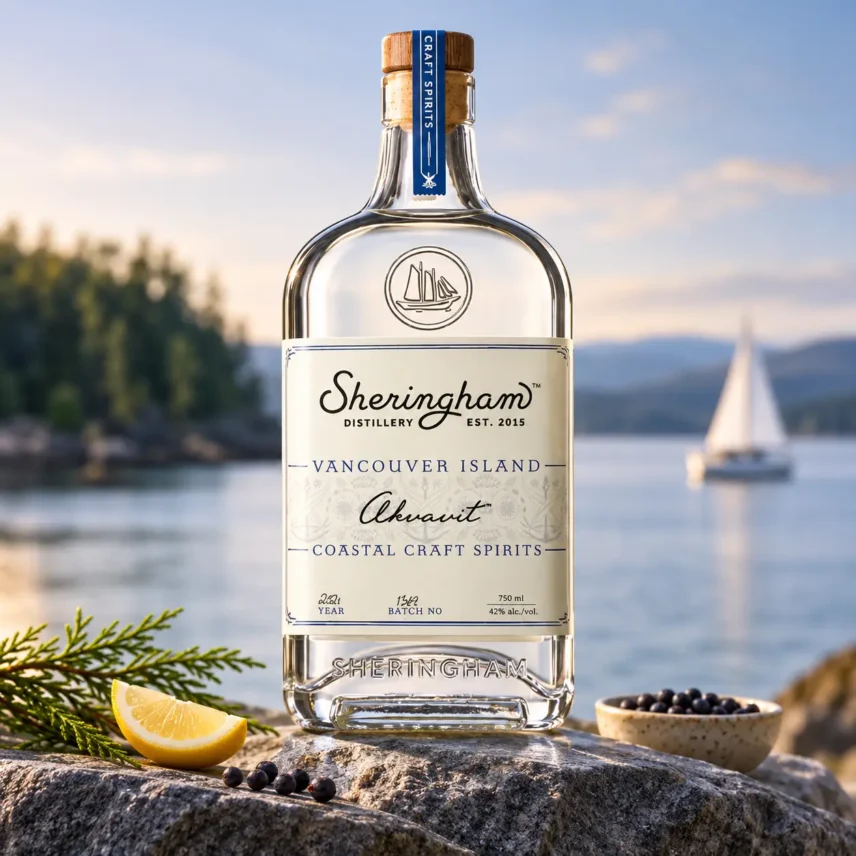
Seaside also plays a role beyond the gin itself. The same winged kelp appears in Sheringham Akvavit, which shows how a single local botanical can shape more than one spirit when a distillery commits to its home landscape.
Anyone building a Canadian gin shelf will find Seaside a natural first bottle, because it shows the West Coast style in its clearest form.
Beacon, Raincoast and London Dry: Three More Expressions of BC Gin
Beacon, Raincoast and London Dry show three very different sides of British Columbia gin. Beacon looks across the Pacific with Japanese inspired botanicals, Raincoast draws on the island’s temperate rainforest, and London Dry proves that a classic style can be made just as well on the West Coast.
Beacon Gin, formerly known as Kazuki Gin, combines juniper and coriander with grapefruit, green tea, cherry blossoms and yuzu peel. Cherry blossoms add a floral, fruity character with polished, rounded edges, while yuzu and grapefruit bring soft citrus and green tea leaves a delicate herbal finish. It won Best in Show at the Canadian Artisan Spirits Competition in 2020 and Gold (Canada) at the World Gin Awards in 2021.
Raincoast Gin is built around juniper, nettle, oak moss and citrus. Sheringham describes it as a bright and balanced, approachable gin inspired by fresh rainfall and the temperate rainforest, with subtle coastal character from the nettle and oak moss. It earned a Silver medal at the World Gin Awards in 2024.
London Dry Gin takes the traditional route, with a balanced bouquet of bright juniper and citrus, a smooth texture and a crisp, dry finish with a faint trace of spice. Under the Canadian standard, the London Dry name means no sweetening agents have been added.
Seen together, these three gins answer a common question about Canadian gin: is it all experimental? The answer is no. A single craft distillery can produce a contemporary botanical gin and a classic London Dry, and the chef led approach to balance shows in both.
For a host, that range is practical. Beacon brings brightness to citrus cocktails, Raincoast suits herbal and savory drinks, and London Dry covers the classics.
The People Behind the Bottle: A Chef’s Approach to Distilling
Sheringham Distillery was founded by Jason and Alayne MacIsaac, who built their first distillery in their garage at home in Shirley, B.C. Jason is cofounder and Master Distiller, and Alayne is cofounder and CEO.
The name comes from that first home. According to the Sheringham story, Shirley is a small Southern Vancouver Island town whose original name was Sheringham. The bottles carry more local history: their design draws on prohibition era moonshine bottles Jason found near a historical still site, and each bottle is embossed with a sailboat inspired by the schooner Favorite.
Jason is a classically trained chef, and that background shapes how Sheringham makes spirits. The brand describes a chef’s approach to distillation: tasting and analysing ingredients, building a mental catalogue of flavors and bringing botanicals together in balance, the way a chef would build a dish.
This approach explains why Sheringham gins feel balanced even when they use distinct botanicals. Kelp, nettle or cherry blossom could easily overwhelm a recipe. In a chef led recipe, each one is measured so that it adds to the whole rather than dominating it.
Alayne leads strategy, brand development, sales and growth, and has spent more than a decade helping grow Sheringham from a small family business. Today the distillery and tasting room sit in Langford, on southern Vancouver Island.
Visiting is the most direct way to understand a Canadian craft distillery. The Sheringham tasting room in Langford offers complimentary guided tastings for visitors of legal drinking age on any day it is open, with no reservation required, and weekend tours that look at the production space, the ingredients and the distillation process. Tours are limited in size, so booking ahead is recommended.
Sustainability and Sourcing in Canadian Craft Gin
Sustainability matters in Canadian craft gin because local botanicals depend on healthy local ecosystems. A distillery that uses wild kelp or farm grown flowers has a direct interest in protecting the coastline and farmland those ingredients come from.
At Sheringham, that starts with the kelp. Winged kelp for Seaside Gin and Akvavit is sustainably harvested by Dakini Tidal Wilds, using pruning methods and timing that respect the plant’s growth and reproductive cycles.
The distillery also lists a range of commitments and recognitions on its sustainability page:
- Signatory of The Climate Pledge.
- BC Green Business Green Leader.
- BC Green Business Water Friendly certified (Surfrider Approved).
- Biosphere Committed designation.
- A water capturing and recycling process at the distillery.
These details help buyers separate genuine sourcing from marketing language. A credible Canadian craft gin can usually tell you where its signature botanicals come from, who harvests them and how. When a producer can name the farm, the harvester and the method, that is a good sign the local story is real.
Sustainability is also part of the reason many Canadian distillers choose gin in the first place. A botanical spirit made close to its ingredients keeps supply chains short for the elements that define its flavor, even when staples such as juniper still travel.
For the full picture, including the distillery’s published goals and its sustainability report, the Sheringham sustainability page is the best source.
Where to Buy Canadian Made Gin Online, Locally and in the US
Canadian made gin can be bought online direct from many distilleries, at provincial and private liquor stores, at distillery tasting rooms and, for some brands, in the United States. Sheringham gin is available through all of these routes.
|
Where |
How to buy Sheringham gin |
|---|---|
|
Online in Canada |
Delivery across Canada, excluding Quebec and New Brunswick |
|
British Columbia |
BCL and private liquor stores, restaurants, cocktail lounges, or online |
|
Alberta |
Private liquor stores, restaurants and cocktail lounges |
|
Ontario |
Select LCBO stores while products last |
|
Nova Scotia |
NSLC stores or online |
|
United States |
Online delivery to most US states and Washington, D.C., plus a US bottle locator |
|
Vancouver Island |
The Sheringham tasting room in Langford |
Canadian buyers can check the Sheringham where to buy page for provincial store links and online ordering. US buyers can order through the Sheringham USA shop, which also has a bottle locator for US retailers.
Yes, Canadian gin can be bought in the US. Availability depends on the brand and the state, since alcohol shipping rules vary across the country. For Sheringham, the US shop delivers to most states and Washington, D.C.
Canadian gin is at its most interesting when it tastes of a place, and gin from British Columbia does that with real clarity. From the legal standard that protects the Dry Gin label to the kelp, lavender and rainforest botanicals of Vancouver Island, the category rewards anyone curious enough to read the label and explore.
Frequently Asked Questions
What makes Canadian gin distinct from other gins on the market?
Canadian gin is distinct because many Canadian distillers build their recipes around local botanicals and a strong sense of place. Every gin must carry juniper, but Canadian producers often add plants from specific landscapes, such as boreal herbs in Quebec or kelp, lavender and rose on Vancouver Island. Much Canadian gin is also made by small craft distilleries that can experiment freely and release limited batches. The federal standard sets the foundation, requiring alcohol from food sources redistilled with or over juniper berries, and it reserves the Dry Gin and London Dry Gin labels for gins with no added sweetening. Sheringham Seaside Gin is a clear example of the style: its winged kelp, harvested on Vancouver Island, gives a subtle taste of the ocean.
How is gin produced differently in Canada compared to traditional gin regions?
Gin in Canada uses the same core method as traditional gin regions, redistilling a base spirit with juniper and other botanicals, but differs in labelling rules, scale and ingredient choices. Canada’s standard requires alcohol from food sources redistilled with or over juniper berries, allows other botanicals during redistillation, and permits the Dry Gin or London Dry Gin label only when no sweetening agents are added. England is home to the London Dry style, while genever from the Netherlands and Belgium uses a malt wine base. In Canada, much of the gin comes from small craft distilleries, and British Columbia created a dedicated craft distillery category in 2013. That small scale encourages regional botanicals and frequent experimentation rather than one fixed national style.
Where can I buy authentic Canadian made gin online and locally?
Authentic Canadian made gin is sold online direct from distilleries, in provincial and private liquor stores, and at distillery tasting rooms. For Sheringham gin, Canadians can order online for delivery across Canada, excluding Quebec and New Brunswick. In British Columbia it is available at BCL and private liquor stores, restaurants and cocktail lounges. Alberta buyers can find it at private liquor stores, Ontario buyers at select LCBO stores, and Nova Scotia buyers at NSLC stores or online. Visitors to Vancouver Island can also buy at the Sheringham tasting room in Langford, which offers complimentary guided tastings. To confirm a gin is authentically Canadian, check the label for where it was distilled and the producer’s website for details on its botanicals and sourcing.
What are the top Vancouver Island gins to try this year and why are they unique?
Sheringham Distillery’s four gins, Seaside, Beacon, Raincoast and London Dry, offer a complete picture of Vancouver Island gin, because each one reflects a different part of the island’s landscape. Seaside Gin uses locally harvested winged kelp, Vancouver Island lavender and B.C. rose, and was named World’s Best Contemporary Gin at the World Gin Awards in 2019. Beacon Gin combines cherry blossoms, green tea, yuzu and grapefruit, and won Best in Show at the Canadian Artisan Spirits Competition in 2020. Raincoast Gin draws on the temperate rainforest with nettle and oak moss, earning Silver at the World Gin Awards in 2024. London Dry Gin offers a clean, classic profile of bright juniper and citrus. Together they range from coastal contemporary to traditional.
Is there a legal definition of gin in Canada?
Yes. Canada defines gin in section 2.3.2 of the Canadian Food Compositional Standards, Volume 2, which is incorporated by reference into the Food and Drug Regulations. The standard previously appeared in the regulations as section B.02.041, and moved to the compositional standards document on December 18, 2024. Gin, other than Hollands or Genever style gin, must be a potable alcoholic beverage obtained by redistilling alcohol from food sources with or over juniper berries, or by blending that redistilled spirit with other alcohol from food sources. It may contain other aromatic botanicals added during redistillation, a sweetening agent and a flavouring preparation to keep the flavor consistent. It may be labelled Dry Gin or London Dry Gin only if no sweetening agents have been added.
Can Canadian gin be bought in the US?
Yes, Canadian gin can be bought in the US, although availability depends on the brand and the state. Alcohol shipping rules vary across the United States, so some brands sell through local retailers while others offer direct online delivery where state law allows. Sheringham Distillery ships its spirits to most US states and Washington, D.C. through its US online shop, which also includes a bottle locator for finding US retailers. US buyers interested in British Columbia gin can use that shop to see which Sheringham gins are available in their area, including Seaside Gin, the winner of World’s Best Contemporary Gin at the World Gin Awards in 2019. Buyers must be of legal drinking age, which is 21 in the United States.